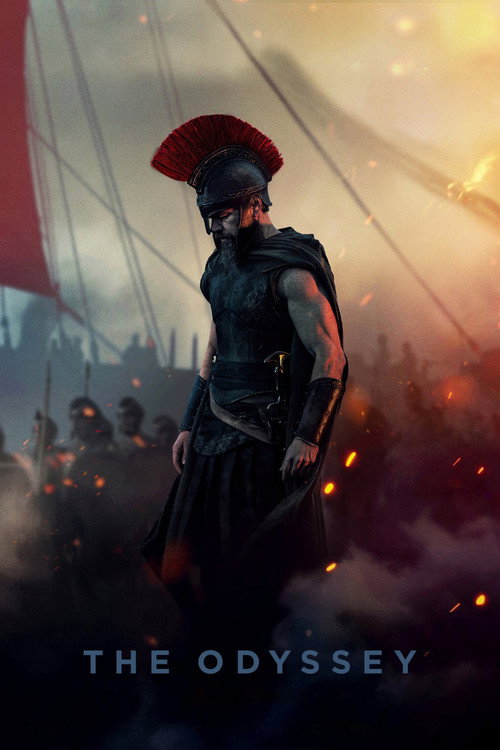
The Odyssey is best seen, as far as I can tell, in 70mm IMAX, from row one, dead in the middle. Unfortunately, I watched it from row five, a little bit to the left, and that meant that I had to close my eyes multiple times to keep from getting dizzy, that the scenes I could see most clearly were giant spreads of the Mediterranean, and that, after a while, I realized I needed to be specifically looking at the top and bottom of the screen to take it in the way Nolan intended. Once I made that decision, I was able to watch the movie without getting dizzy.
The decision to film this for 70mm IMAX worked, in the sense that it created great demand to see it. It just means that, because the price-allocation mechanism is basically taboo for entertainment types, you’re not able to pay to really see it this way if you want. You have to just suck it up and watch it from the fifth row. And that’s a bummer. It’s a bummer that Nolan feels he needs to film movies this way to get asses in seats. I don’t think that’s necessarily true, but it’s a bummer that he feels that need.
Regarding the movie itself, I think that The Odyssey is clearly one of the few recent Greek retellings that is actually good, in a Hollywood that is pretty much never able to retell these Greek stories in a way that actually has some amount of social or cultural impact.
The addition of the Sea Peoples plotline is very interesting. It feels like a sequel, in terms of themes, to Oppenheimer. Here, Odysseus plays Oppenheimer in this interesting way where Odysseus is the person who is destroying the world. Whereas Oppenheimer was talking about how this man basically destroyed the world with technology, Odysseus broke the social code. He broke Zeus’s law.
Zeus’s law is getting a lot of shit online, partly because it’s repeated multiple times in the movie. But there’s a certain sense in which what is different here is that Odysseus has betrayed civilizational culture. Everybody knows that Nolan is quietly making weird right-conservative-type movies, sometimes maybe without intending to. And here Odysseus converts society from a high-trust society to a low-trust society. That is fundamentally what the plot is about.
Helen kills her husband. She, as a wife, is not to be trusted. She’s now low-trust. The suitors, who are products of this devolution from high-trust to low-trust, are now only in it for themselves. They betray each other, and they plan on betraying Penelope.
This is not the same as Oppenheimer, even though it rhymes with that story, because this is about essentially breaking faith with other people. And ultimately, that is the best current understanding of the end of the Bronze Age: the breakdown of trade relationships and trust between the great kings of the Bronze Age kingdoms and empires. So that is what makes this movie interesting.
I think there are some takes I’ve seen floating around about how it’s about civilizational guilt, and it’s certainly about Odysseus’s civilizational guilt. But people aren’t entirely sure what he is guilty of. They seem to be saying that he’s guilty of war crimes, and he’s certainly guilty of war crimes. People have pointed out that the movie is not like The Northman. It isn’t willing to tell you that these people are really terrible rapists, and that’s just how life is. Instead, it just says this guy is guilty of war crimes. The movie codes him like an American GI, but I don’t think that’s actually what it’s about — what he’s guilty of, again, is breaking faith.
Maybe the tropes are useful because we understand those tropes, but ultimately the story, the way Nolan tells it, is about this sense that Odysseus is not a good man. But I don’t think Nolan is fully able to land the punch he’s throwing — even though, to his credit, he does throw it.
Anyway, I think it’s probably already an addition to the pantheon of what I would call “man movies,” such as Apocalypto, The Northman, or The Last Duel. And, yeah, I think it’s worth watching.