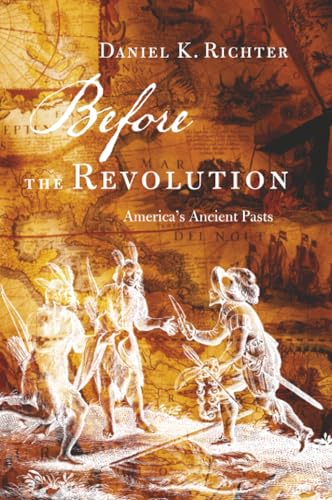
Before the Revolution: America's Ancient Pasts
by Daniel K. Richter
Before the Revolution: America’s Ancient Pasts is a fantastic colonial history. One of the most striking things about it is where it begins: not in the seventeenth or eighteenth century, but in the medieval period, in the late 1200s and 1300s. Richter starts there in order to compare medieval England and medieval North America and to show how these societies were already diverging long before the Revolution itself. The point is that the forces leading up to the American Revolution had very deep roots.
I would compare this book somewhat to Albion’s Seed. Where Albion’s Seed focuses on the first four migratory waves into America, Before the Revolution covers both what was happening in England during those migrations and what was motivating the people who made them. It gives you a broader framework for understanding the colonial world.
This is also the book that brings back one of my high school teacher’s old lines, which has been stuck in my head ever since: that the American Revolution was a sequel to the English Civil War. I am still not completely sure that is true in a clean, literal sense, but after reading Richter, it definitely seems true that the English Civil War left massive scars on the American psyche that extended all the way into the revolutionary period.
The way Richter tells it, there are roughly four phases to this history. First come the colonial beginnings, the era Albion’s Seed partly describes, where people are trying to build little villages, farms, and plantations across the ocean. It is messy, neglected, and often miserable, with plenty of fantasy about finding gold that does not exist. Then comes the English Civil War, which drives major waves of migration, including religious refugees, economic refugees, and eventually people displaced by the broader fact that England is crowded and trying to push population outward. After that, once the Civil War settles, the Atlantic economic system really starts to take shape. This is when a kind of broader Atlantic British identity emerges.
That matters because when you watch something like John Adams, or think about the debates of 1774 and 1775, these people did not yet think of themselves as straightforwardly American. Fundamentally, they were British. They lived inside the British system. They bought British goods, traded with British merchants, and moved through British institutions. In some ways, it would have felt less like a foreign relationship and more like a person in California trading with someone in New York.
One thing this book pushes against is the revisionist story that the American Revolution was simply a matter of rich white settlers wanting lower taxes and independence from Britain so they could do whatever they wanted. That version often feels like it takes current political categories and retrofits them onto the eighteenth century, as though the Founders were basically modern Republicans and the British were some kind of socialist Labour government trying to fund the NHS. That is obviously an exaggeration, but not by as much as some modern interpretations would like.
The Revolution does not need to be glamorized. It is very clear that many colonial settlers, rich and poor alike, wanted access to Indigenous land, and that the British were trying to restrain westward expansion because they did not want to pay for the conflicts it would trigger. It is also clear that, in trying to hold the empire together after the Seven Years’ War, and in trying to govern newly acquired French populations, Britain had to create systems of governance that did not fit what the colonial settlers were used to.
One way to imagine this is to picture the federal government suddenly incorporating territories that are directly controlled by the president rather than treated like ordinary states. You can imagine how unsettling that would feel to people living in the existing system. Richter makes clear that the Revolution was not just rich white people fighting other rich white people over money. It was a society in the middle of a profound political, economic, and imperial divorce.
Other books, like The American Revolutions, make it clear that this break may not even have made immediate sense from a narrow short-term economic perspective. And that itself suggests that there was more going on than simple material self-interest.